
 EN
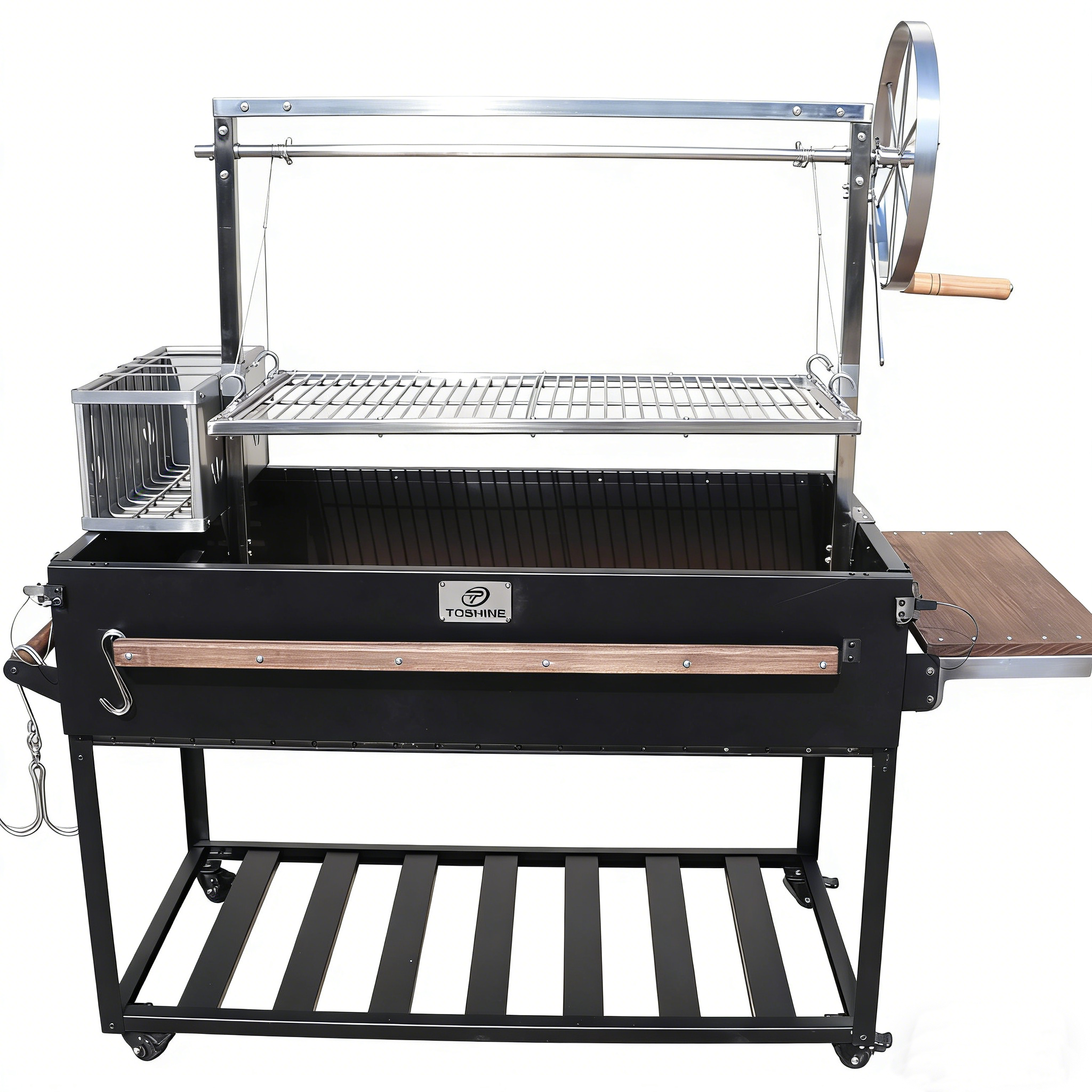
Engineering Heritage: How the Santa Maria Grill’s Adjustable Height System Merges Tradition and Precision
The Counterweighted Lever Mechanism: Real-Time Fire-to-Grill Distance Control
At the heart of every Santa Maria grill lies a deceptively simple counterweighted lever system. A hand-crank, pulley, and cable assembly—often concealed within the upright post—enables the cook to raise or lower the entire grate over red oak coals with one continuous motion. This real-time vertical travel spans 12 inches or more, instantly modulating heat intensity. Lowering the grate to within inches of the embers delivers surface temperatures exceeding 700°F for an aggressive sear; lifting it to the highest position drops effective heat by hundreds of degrees, creating a gentle, indirect zone ideal for finishing thick cuts or warming sides.
Unlike fixed-grate charcoal or gas grills—where heat control relies solely on airflow—the Santa Maria’s adjustable height transforms fire management into an intuitive physical act. The counterweight renders the heavy steel grate nearly weightless, enabling precise, on-the-fly micro-adjustments. This direct mechanical relationship between pitmaster and flame is why live-fire enthusiasts prize the design: it replaces the guesswork of two-zone cooking with a fluid, responsive dialogue between distance and temperature.
From Ranch Iron Rods to CNC-Calibrated Stainless Steel: A 150-Year Evolution
The first Santa Maria grills were built from whatever materials California ranchers had on hand in the mid-19th century: salvaged wagon-wheel rims for the firebox, forged iron rods for the grate supports, and rudimentary hand-operated windlasses for height adjustment. Functional but crude, these early lifts demanded two hands and steady nerves to manage heavy loads over open flame.
Over time, the core counterweighted lever concept remained unchanged—but materials and manufacturing evolved dramatically. Modern Santa Maria grills use CNC-laser-cut stainless steel for uprights, gears, and lifting tracks, ensuring zero-play fits and smooth cranking under full load. Stainless steel resists coastal corrosion while enabling ultra-smooth telescoping movement. Precision ball-bearing pulleys and marine-grade cable have replaced rough-hewn rope, and ergonomically designed aluminum crank wheels replace worn wooden handles.
This 150-year evolution—from ranch-made iron rods to CNC-calibrated components—delivers the same hands-on ritual with vastly improved durability and refined operation. It affirms that true innovation often lies not in discarding tradition, but in perfecting it.
Precision Heat Management: Eliminating Guesswork with Santa Maria Grill Height Adjustment
Temperature Science: ±45°F Surface Variance per 1.5" Height Change
The Santa Maria grill’s adjustable grate transforms fire management into precise thermal control. Independent thermal mapping studies confirm that raising or lowering the cooking surface by just 1.5 inches changes effective grate temperature by approximately ±45°F. This linear, mechanical relationship allows cooks to respond instantly to flare-ups, fat vaporization, or delicate proteins—without adding or removing fuel.
An infrared snapshot of a 2-inch searing zone may read 650°F; at 3.5 inches, the same area drops to ~605°F—still hot enough for steady roasting. The counterweight mechanism makes these micro-adjustments instant and repeatable, eliminating the temperature inconsistency inherent in fixed-height grills. By giving the operator literal leverage over heat intensity, the Santa Maria design turns live-fire cooking into a predictable, measured process—one that thermostatically controlled appliances cannot replicate with the depth of wood-fired flavour.
Competition-Validated Consistency: 92% Uniform Char Mark Replication Across Batches
In rigorous head-to-head evaluations, Santa Maria grill height adjustability has proven its value beyond anecdote. A multi-season analysis of professional steak-cookoff judging data revealed that chefs using crank-operated adjustable grates achieved 92% uniformity in char mark pattern replication across identical cuts. This consistency stems from the ability to lock the grate at the exact height that delivered the ideal Maillard sear in prior batches.
Unlike fixed setups—where ambient wind or ember decay introduce variation—the Santa Maria’s vertical travel compensates instantly, preserving metal-to-meat contact round after round. That’s why competition teams rely on these rigs for high-volume service where plate-by-plate sameness is non-negotiable. For the home cook, that 92% figure translates directly to confidence: the first steak off the grill will look and taste just like the tenth.
Protein-Specific Versatility: Optimizing Santa Maria Grill Height for Every Cut and Cooking Method
Height-to-Protein Framework: Skirt Steak (2") vs. Tri-Tip (4") vs. Whole Chicken (8")
The Santa Maria grill’s hand-cranked grate turns a single fire bed into a dynamic, multi-zone cooking surface. By adjusting distance from the coals, you shift seamlessly from blistering radiant heat to gentle convection—an advantage fixed-height barbecues simply can’t match. The table below distills the core height-to-protein framework:
| Height Above Coals | Protein | Technique | Target Internal Temp |
|---|---|---|---|
| 2 inches | Skirt steak | Flash-sear both sides to develop crust | 130 °F (medium-rare) |
| 4 inches | Tri-tip | Sear at 2 inches, then roast at 4 inches | 130–135 °F |
| 8 inches | Whole chicken | Slow-roast with lid down, turning once | 165 °F (thigh) |
This calibrated approach ensures repeatable results. Thin cuts like skirt steak demand intense, brief heat: the 2-inch setting delivers 700+°F surface temperatures that trigger the Maillard reaction in under two minutes per side—raising the grate immediately after searing prevents bitter charring. Tri-tip, with its irregular shape and higher connective tissue content, benefits from the sear-then-elevate method: a 2-inch burst locks in juices, while the 4-inch position provides indirect heat equivalent to a 350°F oven—melting collagen without drying lean muscle. Whole chicken, a thick, cavity-prone protein, requires even, penetrating heat. At 8 inches, gentle drafting heat acts like a rotisserie—crisping skin, rendering fat over 75 minutes, and guiding internal temperature steadily to safe doneness.
This height-based zoning replicates what multi-burner gas grills achieve with valves—but with the nuance, responsiveness, and unmistakable character of live fire.
FAQs
What is the main advantage of the adjustable height system in Santa Maria grills?
The adjustable height system enables precise heat control by modulating the distance between the cooking surface and the coals. This transforms fire management into a responsive physical act that eliminates guesswork.
How does the construction of modern Santa Maria grills improve performance?
Modern Santa Maria grills use CNC-laser-cut stainless steel, precision ball-bearing pulleys, and marine-grade cables for smooth operation and enhanced durability, resisting corrosion and wear.
Can the adjustable height system handle different types of proteins?
Yes, the system allows for tailored cooking depending on the protein. For example, searing thin cuts like skirt steak at 2 inches, roasting tri-tip at 4 inches, and slow-roasting whole chickens at 8 inches ensures optimal results.
How does the Santa Maria grill ensure temperature consistency?
The adjustable height allows instant, repeatable micro-adjustments in temperature by altering the grate’s distance from the heat source, producing consistent results regardless of environmental variables.
Why do professional chefs prefer Santa Maria grills?
The precise height adjustment system ensures uniform results, such as 92% consistency in char marks, making these grills reliable for competition and high-volume cooking.